
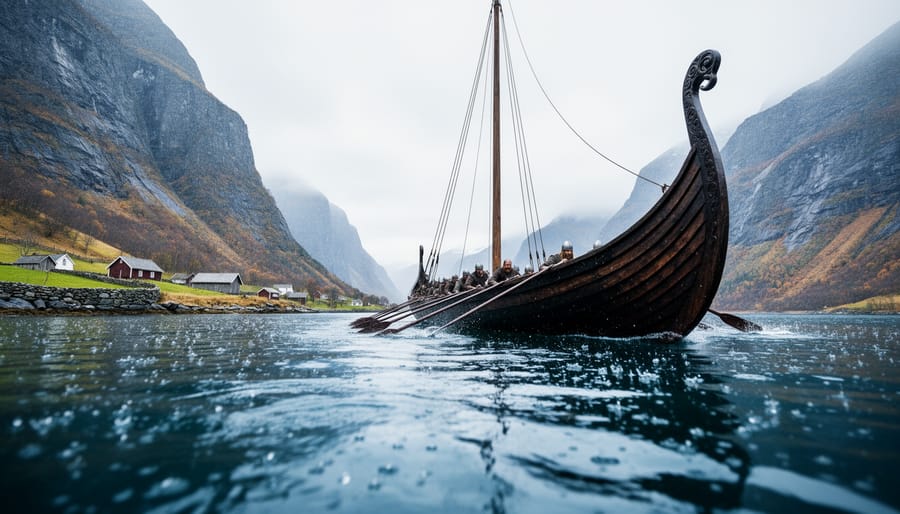
Yes, many Vikings came from Norway, but not all of them. “Viking” describes a seaborne raider, trader, or explorer from Scandinavia during roughly 793 to 1066 AD, and the people who took up that life came from what is now Norway, Denmark, and Sweden. Norwegians sailed mostly west, to Scotland, Ireland, Iceland, Greenland, and eventually North America. Danes pushed into England and Frankia. Swedes travelled east along the rivers of Russia toward Constantinople.
So the honest answer is “Norway was a major homeland, not the only one.” That nuance matters, because it changes how you read the landscape when you visit. The fjords that sheltered Norwegian longships, the farm mounds that still dot the countryside, the harbours where voyages began: all of it is still there to be seen, and much of it is far quieter than the famous museums in Oslo.
This article explains who the Vikings were, how Norway’s coastline turned farmers into seafarers, and what the different voyages tell us. It also shows how to use that knowledge to plan a slower, more thoughtful trip to lesser-known Norwegian heritage sites, the kind of travel that gives back to local communities rather than crowding them.
What ‘Viking’ Actually Means (and Where Norway Fits In)
The word “Viking” comes from the Old Norse víkingr, and it described something a person did, not a people they belonged to. To “go á víking” meant to head overseas on an expedition, whether to trade, explore, raid, or settle new land. A man might sail on one such voyage in his youth, then spend the rest of his life tending a farm back home.
That distinction matters, because the vast majority of Norse people never set foot on a longship at all. Most were farmers, fishers, craftspeople, and traders who worked the land and the shoreline much like their neighbors do today. The image of an entire population sailing off to plunder is a later invention, one that owes more to Victorian paintings and Hollywood costume departments than to the historical record. And yes, the horned helmets are a myth too.
So when we ask whether Vikings came from Norway, we are really asking where these seafaring adventurers set out from. The honest answer is that a great many did sail from Norwegian fjords and coastal farms. But “Viking” never meant “Norwegian,” and understanding that gap is the key to making sense of everything that follows.
Norway, Denmark, and Sweden: Three Homelands
Historians usually group the Viking world around three homelands, each with its own favorite horizons. Norway, with its long, fjord-cut coastline facing the open ocean, looked west. Norwegian seafarers pushed across the North Atlantic to the Shetland and Orkney islands, the Faroes, Iceland, Greenland, and even a brief foothold in Newfoundland.
Denmark, flatter and closer to the busy trade routes of the continent, tended to look south and southwest. Danish Vikings were especially active in England and along the coasts of what is now France and the Low Countries. Sweden, sitting on the Baltic, turned east. Swedish Norse traveled along Russian and Ukrainian rivers, trading as far as Constantinople and beyond.
These are tendencies, not strict borders. Crews mixed, fleets joined forces, and political lines shifted constantly. Still, the pattern helps explain why Norway’s story is so tied to the sea routes to the west, which is where we head next.
How Norwegian Vikings Became Seafarers
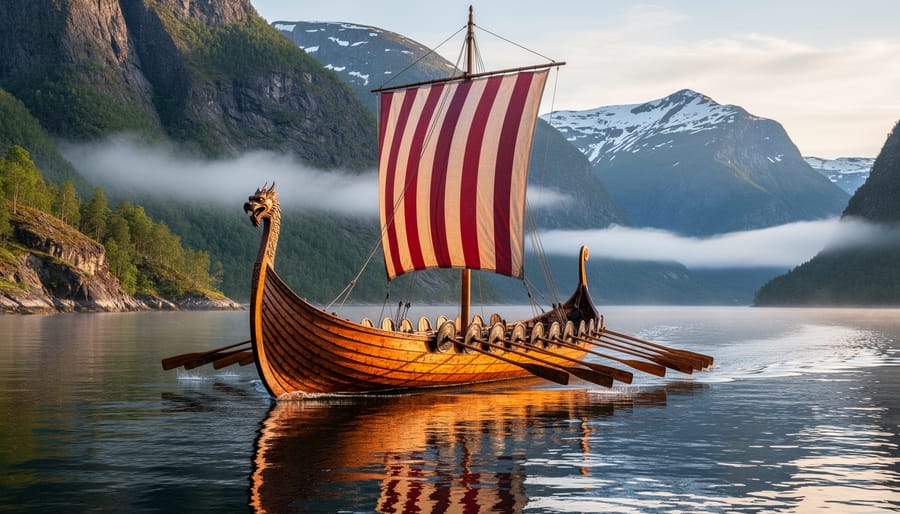
Fjords, Farmland, and Ships
Norway’s coastline did a lot of the early work for its seafarers. Long, narrow inlets cut deep into the land, giving sheltered harbors, calm routes between settlements, and quick access to open water. If you’re curious about how fjords formed the short version is that glaciers gouged out valleys that the sea later filled. The result was a country where most communities lived within sight of the water.
Farmland was a different story. Steep mountainsides left only small patches of fertile soil, so a family farm could only support so many people. Fishing, sealing, and trading by boat became natural ways to make a living, and a younger son with no land to inherit had good reason to look overseas.
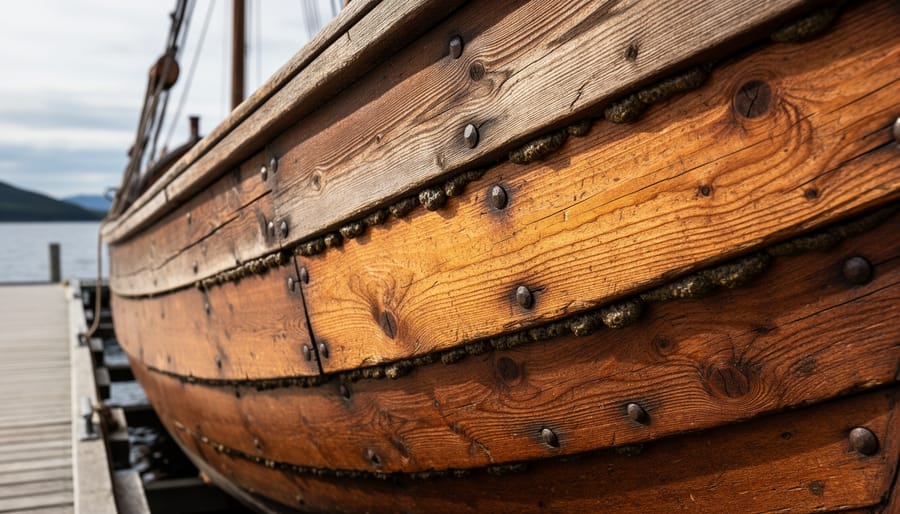
The ships made it possible. Norse builders used clinker construction, overlapping oak planks fastened with iron rivets over a keel. This made hulls light, flexible, and strong enough to flex with ocean swells instead of cracking. A shallow draft let crews land on open beaches or row up rivers, while a single square sail carried them across the North Sea. Skills like this took generations to develop, which is why Norway’s boat-building tradition runs so deep.
From Local Chieftains to a Kingdom
Before Norway was a kingdom, it was a patchwork of regions, each ruled by local chieftains and petty kings who competed for land, loyalty, and prestige. That rivalry mattered. A chieftain who lost a power struggle at home might gather his followers and sail abroad, while a rising leader needed wealth and plunder to reward the warriors who backed him. In this way, politics at home helped push crews out to sea, and much of the Viking history of Norway grows out of these local contests.
Later, kings such as Harald Fairhair are traditionally credited with bringing the coastal regions under one rule in the late ninth century. Tradition says some who resisted unification left for the North Atlantic islands, which fits the wave of settlement in places like Iceland. Others stayed and served the new order.
Still, it pays to be cautious. Historians debate how complete this early unification really was, and when it happened. Our best stories come from sagas, many written down in Iceland centuries after the events they describe. They are rich, valuable windows into how Norse people saw their past, but they are not always literal history. Think of them as strong clues rather than courtroom records.
Where Norwegian Vikings Sailed and Settled
Norway’s Westward Voyages
Norwegian Vikings were the great westward travelers of the Viking Age. Their ships pointed toward the open North Atlantic, and island by island they pushed farther from home.
The first stepping stones were close to the Norwegian coast. Norse settlers established themselves in Shetland and Orkney, then spread through the Hebrides and parts of mainland Scotland, as well as Ireland. Place names in these regions still carry Old Norse roots, a quiet reminder of how thoroughly the settlers put down roots.
Farther out, the Faroe Islands became another Norse outpost. From there, Iceland came next. Settlement began in earnest in the late 800s, and the Icelandic sagas, written down centuries later, preserve the memory of families who left Norway to find new farmland and, in many accounts, to escape the growing power of ambitious chieftains and kings at home.
Greenland followed around 985, when Erik the Red, born in Norway and exiled from Iceland, led settlers to its southwestern fjords. Norse communities survived there for several centuries.
The most astonishing leap was to North America. At L’Anse aux Meadows in Newfoundland, archaeologists have uncovered the remains of a Norse camp dating to around the year 1000. It appears to have been occupied only briefly, but it is firm evidence that Norse seafarers reached the continent roughly five hundred years before Columbus.
None of this was possible without ships and navigation built for rough, open water, which is why this westward story is so strongly tied to Norway.
How Danish and Swedish Vikings Differed
Norwegian Vikings sailed mostly west, but their neighbors pointed their ships in other directions. That difference is the clearest sign that “Viking” was never a single national story.
Danish Vikings looked south and southwest. Their raids and settlements centered on England, the Frankish lands, and the Low Countries. They were behind the large armies that took on Anglo-Saxon kingdoms, and the area of eastern England once ruled under Norse law came to be known as the Danelaw. Later, Danish kings such as Cnut the Great even ruled England as part of a North Sea empire.
Swedish Vikings turned east. They followed the Baltic and then the great Russian rivers, building trade routes toward the Black Sea and the Byzantine and Islamic worlds. Many are linked to the Rus, whose river networks helped shape early states in what is now Russia and Ukraine. Their focus was often silver, furs, and slaves rather than coastal raiding.
Of course, these were tendencies, not strict borders. Crews mixed, alliances shifted, and a Norwegian, a Dane, and a Swede might have shared the same longship. Still, the pattern helps explain why Norway’s story leans toward islands and open ocean.
Famous Norwegian Vikings and the Evidence Behind Them
Some of the best-known names in Norwegian Viking history come with a caveat: their stories were mostly written down generations, even centuries, after they lived.
Harald Fairhair (Harald Hårfagre) is traditionally credited with uniting Norway under one crown in the late 800s, supposedly after the Battle of Hafrsfjord. The sagas treat this as a turning point, but historians are cautious. The main accounts, such as Snorri Sturluson’s Heimskringla, date from the 1200s, so the “first king of Norway” story is partly tradition, and the unification likely happened more gradually than the tale suggests.
Erik the Red sits on firmer ground as a figure of the North Atlantic. Born in Norway, he was exiled from Iceland and went on to found Norse settlements in Greenland around 985. His son Leif Erikson is linked in the sagas to Vinland, and archaeology backs up the broad picture: the site at L’Anse aux Meadows in Newfoundland confirms Norse presence in North America around the year 1000. What the sagas add, such as exact routes and personal conversations, is harder to verify.
So how do historians separate fact from storytelling? They triangulate. Each source type has strengths and blind spots:
- Ship burials, like the finds at Oseberg and Gokstad, show how the elite lived and how advanced Norse shipbuilding was.
- Runestones record names, family ties, and events in the words of the people themselves, though usually in just a few lines.
- Sagas preserve rich stories and traditions, but they were written later and blend history with literature.
- Trading town excavations, such as Kaupang, reveal everyday commerce, crafts, and international connections.
- DNA and isotope studies help trace where people were born, how far they travelled, and who they were related to.
When several of these point in the same direction, historians gain confidence. When only a saga tells the tale, the honest answer is often “possibly, but unproven.” That mix of solid evidence and lively legend is part of what makes Norwegian Viking history so rewarding to explore.
Seeing Norwegian Viking History Today: Sites and Responsible Travel
Lesser-Known Viking Sites Worth the Detour
Skip the crowds in Oslo and head to places where the Viking Age feels closer to the ground. Avaldsnes, on the island of Karmøy, sits beside the Karmsundet strait, a narrow sea lane that Norse rulers once controlled. Tradition links it with early royal power, and the setting makes it easy to see why this spot mattered. The Nordvegen History Centre here explains the story well. Opening hours and exhibitions change, so check ahead before you go.
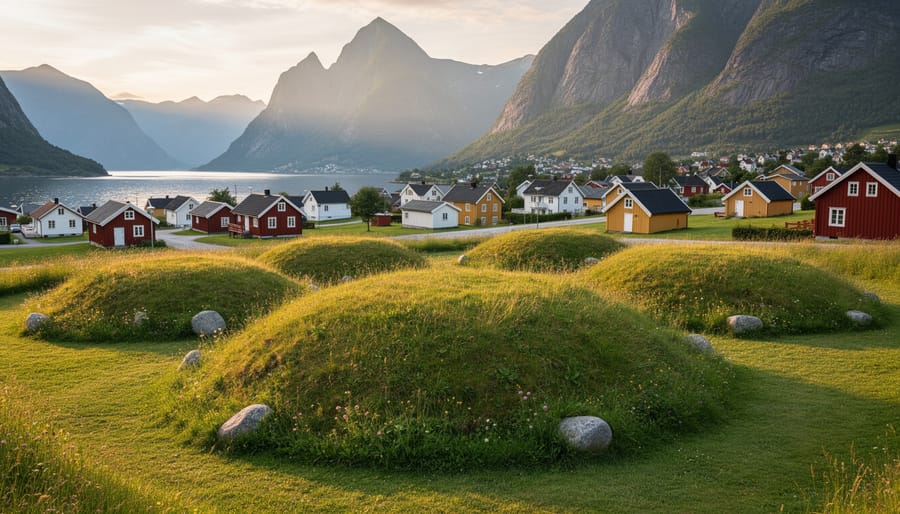
Borre, in Vestfold, is a quiet national park where large burial mounds rise from open grass and woodland. It’s a peaceful place to walk, and the path signs help you read the landscape. Treat the mounds as the graves they are: stay on marked trails and don’t climb on them.
Far north in Lofoten, the Lofotr Viking Museum rebuilds a chieftain’s longhouse on the site where the original stood. You can step inside, try crafts, and sometimes join seasonal activities. The surrounding scenery shows how fjord, farm, and sea shaped daily life.
A few low-impact habits help all three stops:
– Travel by train, bus, or ferry where you can, and pair stops along one route instead of making many short trips.
– Visit in spring or autumn, when sites are quieter and local guides have more time to talk.
– Buy tickets, books, or a coffee from the on-site museums, since that money supports the people caring for these places.
If your route starts on the west coast, the Bergen fjord gateway makes a handy base for reaching heritage sites by public transport, with the fjords as a bonus.
Planning Tips for Families and Solo Travelers
Families and solo travelers both do well when Viking history is hands-on. At Lofotr in Lofoten, kids can try on replica clothing, row a boat, and watch craft demonstrations, while solo visitors often enjoy joining a guided tour for the stories behind the longhouse. Many sites run seasonal events with reenactments and market days, so check the calendar before you book.
Pair each heritage stop with fresh air. After the Borre burial mounds, walk the nearby forest and shoreline trails. Near Avaldsnes, the coastal paths of Karmøy make an easy, low-impact break between exhibits.
If you’re visiting in winter, many outdoor sites have shorter hours, so confirm directly with the museum. That said, the dark months have their own appeal, especially if you time your trip around Northern Lights season. Local festivals, too, often weave Viking themes into Norwegian traditions throughout the year, giving you another reason to travel slowly and support small local operators.
Common Questions About Vikings and Norway
Plenty of follow-up questions come up once you start digging into Norway’s Viking past. Here are the quick answers, so you can head into the sagas or a museum visit with a clear picture.
Were all Vikings Norwegian?
No. Norse seafarers also came from Denmark and Sweden, and each group tended to favor different routes. Norwegians mostly sailed west across the North Atlantic.
Did Vikings really wear horned helmets?
No, there’s no archaeological evidence for it. The horned-helmet image comes largely from 19th-century art and opera costumes, not from the Viking Age itself.
Is “Viking” a nationality?
Not really. The word described an activity, going on overseas expeditions, rather than a country or a single people. Most Norse people spent their lives farming, crafting, and trading at home.
Did Vikings reach North America?
Yes. Norse voyagers from the Greenland settlements reached Newfoundland, and the site at L’Anse aux Meadows shows they built a short-lived camp there roughly a thousand years ago.
Where can I see real Viking artifacts in Norway?
Oslo’s Viking Ship Museum is the best-known collection, though you should check its current status before you go, since it has been under redevelopment. For a quieter experience, the Lofotr Viking Museum in Lofoten and the royal site at Avaldsnes on Karmøy are well worth the detour.
If one question lingers, it’s usually “so who counts as Norwegian?” The honest answer is that the modern country didn’t exist yet. The people we now link to Norway were regional communities under local chiefs, and only later did kings begin pulling them together into a single kingdom.
That’s also why the sagas are best treated as rich storytelling rather than a literal record. They’re valuable windows into how Norse people saw themselves, but historians cross-check them against runestones and archaeology. Keeping that balance in mind will make every museum label and trailside sign a little more rewarding.
So, did Vikings come from Norway? Yes, many of them did, especially the seafarers who pushed west across the North Atlantic to the Shetlands, Iceland, Greenland and even the coast of Newfoundland. But the Viking world was never a single nation. Norse people from Denmark and Sweden sailed, traded and settled alongside them, each group following its own routes and ambitions. “Viking” was something you did, not something you were born as.
The best way to feel that story is to walk it. Stand among the burial mounds at Borre, look out over the waters near Avaldsnes, or step into a reconstructed longhouse in Lofoten. Choose the quieter heritage sites over the crowded ones, take the train or ferry when you can, and visit outside peak season so local communities benefit without being overwhelmed. Check opening hours and exhibitions before you go, since plans change.
Norway has plenty more to share beyond its Viking past. Keep exploring, stay curious, and let the fjords and the old stories lead you somewhere new.