
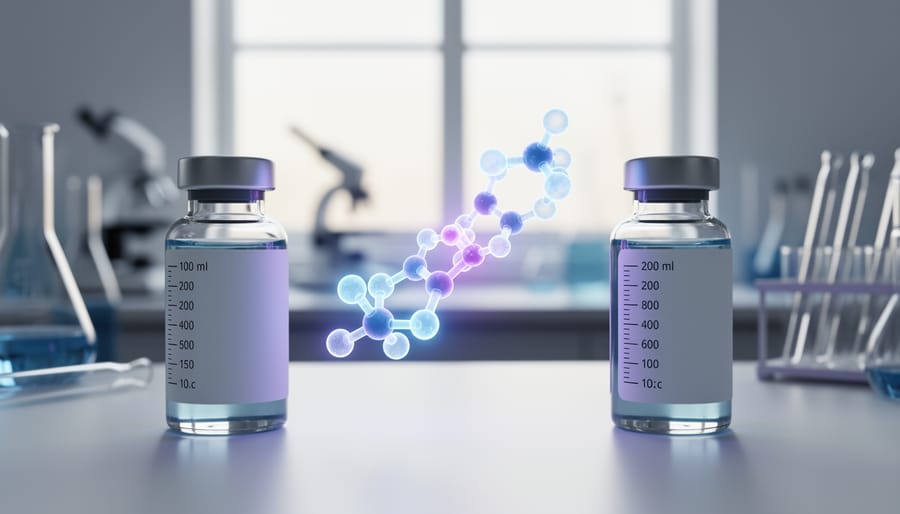
Peptides are short chains of amino acids, the same building blocks that make up proteins, just much smaller. Your body produces thousands of them, and they act as chemical messengers, telling cells when to grow, repair, rest or respond. Scientists group them by what they do. Growth hormone secretagogues are peptides that prompt the pituitary gland to release more of the body’s own growth hormone. A research peptide supplier often sorts these by category, and nootropics are another group, peptides studied for their effects on memory, focus and mental clarity. Different jobs, different targets, and very little overlap.
Why does the distinction matter? Because the word “peptide” gets stretched to cover everything from skincare ingredients to lab compounds, and that confusion makes it hard to judge what a claim really means. A research peptide supplier typically sorts products by category for exactly this reason, since each group has its own research history, evidence base and rules.
Think of it like planning a trip to Norway. Fjords, mountains and Arctic coast all count as “scenery,” but you wouldn’t pack the same way for each. This guide walks through what peptides are, how they work, the main types, and where evidence and legality draw firm lines, so you can read the science with a clear head.
What Peptides Are and Why Sorting Them Into Categories Helps
Think of amino acids as letters. String a few together and you get a short word; string hundreds together and you get a long sentence. A peptide is the short word: a small chain of amino acids, usually somewhere between two and fifty. A protein is the long sentence, a much bigger chain that folds into a complex shape. The line between them is a bit fuzzy, but the size difference is the easiest way to remember it.
Peptides get named by what they do. One tells your pancreas to release insulin, another nudges your pituitary gland, another helps skin hold its structure. Since there are hundreds of compounds, sorting them by purpose is how researchers, clinicians, and regulators keep track of them. A category tells you what a compound is meant to do, and that shapes how it gets studied, approved, and regulated.
Here are a few terms that will come up again:
- Peptide
- A short chain of amino acids that acts as a chemical messenger in the body.
- Amino acid
- A small building block, like a single letter, that links with others to form peptides and proteins.
- Protein
- A much longer chain of amino acids that folds into a specific shape to do a particular job.
- Hormone
- A messenger released into the bloodstream that tells distant organs how to behave.
- Receptor
- A docking spot on a cell that a messenger fits into, like a key in a lock, triggering a response.
- Secretagogue
- A compound that prompts the body to release something, such as a hormone, rather than supplying it directly.
One distinction matters more than any other here. Some peptides are made naturally by your own body. Others are approved medicines, such as insulin, tested in clinical trials and prescribed by doctors. A third group is research compounds, studied in labs but not approved for general use. They can sound equally scientific, yet they are very different things.
How Peptides Work Inside the Body

Think of a peptide as a message sent through the body. Your cells carry receptors on their surface, and each receptor is shaped to recognize particular signals. When a peptide arrives with the right shape, it fits the receptor like a key sliding into a lock. That connection tells the cell to do something: release a hormone, ease inflammation, take up sugar from the blood, or send a signal along a nerve.
What makes this useful is how specific it is. A peptide that fits one kind of receptor won’t bother the others, so a small amount can set off a precise response. This is why groups like growth hormone secretagogues and nootropic peptides can behave so differently even though they’re built from the same basic parts, amino acids strung together in different orders.
There’s a catch, though. Peptides are fragile. Enzymes in the blood and digestive system chop them up fast, sometimes within minutes. That’s why many peptide medicines are given by injection rather than swallowed, since stomach acid would simply dismantle them before they did any good. Scientists also tweak the structure of some compounds so they last longer in the body.
So the route a peptide takes and how stable it is matter a great deal. A signal that disappears before it reaches the right lock does nothing at all.
The Main Types of Peptides, Grouped by Purpose
Growth Hormone Secretagogues: Peptides That Prompt the Body’s Own Signals
Growth hormone secretagogues, often shortened to GHS, work like a nudge rather than a delivery. Instead of supplying growth hormone itself, they encourage the pituitary gland, a pea-sized organ at the base of the brain, to release some of its own. Think of it as asking the body to send the message, not handing over the finished product.
There are two broad groups. The first is growth hormone-releasing hormone (GHRH) analogs, which copy the natural signal that tells the pituitary to release growth hormone. Sermorelin and CJC-1295 are the names you’ll see most often here. The second group is ghrelin-mimicking compounds. Ghrelin is best known as the “hunger hormone,” but it also triggers growth hormone release, and Ghrelin mimetic secretagogues are designed to imitate that effect. Ipamorelin is a commonly discussed example. These names are illustrations, not recommendations.
Regulatory status is where things get tricky, and it’s worth being plain about it. A few compounds in this space have been used under medical supervision for specific diagnosed conditions, with a doctor monitoring the results. Many others are sold online as “research chemicals,” which means they are not approved for human use and aren’t held to the purity or dosing standards of real medicines. That gap is exactly why quality and contamination concerns come up so often.
There’s one more catch for anyone who’s athletic. Sport anti-doping bodies prohibit growth hormone secretagogues, so using them can lead to a ban in competition. If you’re curious, a licensed healthcare professional is the right person to ask, not a product listing or a forum thread.
Nootropic Peptides: Compounds Studied for Focus and Memory
“Nootropic” is a term coined in the 1970s for substances said to boost memory, focus, or learning. The word shows up far more often in supplement marketing than in medical textbooks, and no regulator treats “nootropic” as an approved category of medicine. When someone says “nootropic peptides,” they usually mean short protein chains that people discuss in connection with attention, mood, or mental sharpness.
A few names come up again and again. Semax and Selank were developed in Russia, where they have been studied and used in some clinical settings, but they are not approved as medicines in most other countries. Cerebrolysin is a mixture of peptides derived from pig brain tissue. It is used under medical supervision in parts of Europe and Asia for conditions such as stroke and dementia, which is very different from the casual “focus boost” pitch you’ll see online.
Here’s the honest picture of the evidence. Much of the research is small, short, or published in languages other than English, which makes it hard to verify or compare. Large, well-controlled trials in healthy adults are scarce. A promising result in a handful of patients does not mean a compound will sharpen your mind on a busy day.
Availability and legal status also vary widely. A product sold openly in one country may be a prescription-only drug, or simply illegal to import, in another. If you’re packing for a trip, even something as ordinary as a week at a Bergen fjord base, check the medication rules of the country you’re entering first.
So treat bold cognitive claims with healthy skepticism. If a product promises dramatic memory gains with no caveats, that’s a signal to read more, not buy faster.
Other Peptide Categories Worth Knowing
Beyond growth hormone secretagogues and nootropics, a few other groups come up often. Here’s a quick map of what each one does and where it generally stands with regulators.
- Metabolic and weight-management peptides, such as GLP-1 receptor agonists, help regulate appetite and blood sugar, and they are approved prescription medicines.
- Tissue-repair and recovery peptides are studied for helping muscles, tendons and skin heal, and many of them remain experimental rather than approved.
- Skin and cosmetic peptides, including collagen peptides and those found in skincare, are meant to support skin appearance and are sold as ordinary consumer products.
- Immune-related peptides help the body’s defenses communicate, and they range from approved treatments to compounds still in research.
It’s worth noticing how different these groups are in standing, even though they share the same basic building blocks. The GLP-1 medicines have been through extensive clinical testing, while many recovery-focused compounds have not. Collagen peptides in a smoothie or a face cream sit in yet another lane altogether.
So when you see the word “peptide” on a label or a website, ask which category it belongs to and whether it is approved for what’s being claimed. That one question clears up a lot of confusion.
How Peptides Are Used and Where the Evidence Stands

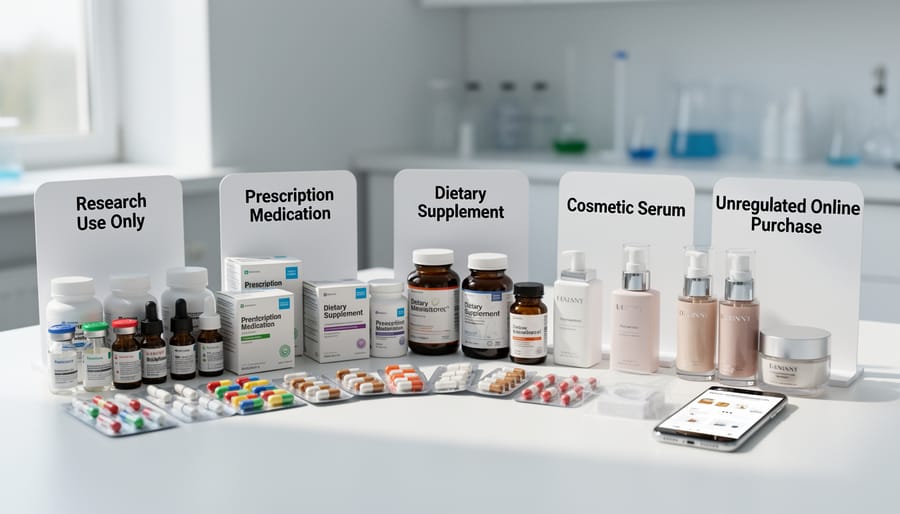
Peptides show up in four quite different places, and mixing them up is where most confusion starts. First, approved medicines: insulin and the GLP-1 drugs used for diabetes and weight management are peptides that have passed safety and quality review, with set doses and a prescriber watching over them. Second, clinical research, where scientists test newer compounds under controlled conditions to see whether they work at all. Third, cosmetics, where peptides in skincare or collagen supplements are generally low-stakes and sold under consumer rules. Fourth, the gray market of “research peptides,” often labeled not for human use, which is a different category altogether.
That last group is where the real concerns sit. Without regulatory oversight, a vial may contain less, more or something other than what the label claims. Contamination, inconsistent dosing and unknown long-term effects are all genuine risks, and the human evidence for many of these products is thin. Being in the same family as an approved drug does not make an unregulated product equivalent to it.
A licensed healthcare professional can tell you what is actually appropriate for your situation, which no forum thread can. The same caution applies to travel. If you use any prescription medicine, check the import rules before crossing a border. Norway has specific requirements for prescription medicines and restricts certain substances, so consult the official Norwegian authorities, such as the Norwegian Medicines Agency, rather than relying on message boards. Planning like this is part of thinking about recovery and climate on an active trip: good preparation matters more than any shortcut.
Common Questions About Peptide Categories
Readers tend to ask the same handful of things when they first meet this topic, so here are straight answers, followed by a bit of context.
Are peptides the same as steroids?
No. Peptides are short chains of amino acids that act as messengers, while steroids are fat-based molecules built from cholesterol. They work through different pathways and belong to different drug families.
Are growth hormone secretagogues legal?
It depends on the compound and the country. Some are prescribed for specific medical conditions, while many sold online are labeled “research use only” and are not approved for people. Sport anti-doping bodies also prohibit them.
Do nootropic peptides actually work?
The evidence is thin. Most claims rest on small or older studies, and “nootropic” is more of a marketing label than a medical category, so bold promises about focus or memory deserve skepticism.
Can I bring peptide medication into Norway?
Prescription medicines face specific rules when crossing the border, and some substances are restricted outright. Check with official Norwegian authorities before you travel, and carry documentation from your prescriber.
How do I tell a medical peptide from a research chemical?
Approved peptide medicines come with a prescription, regulatory approval, and a pharmacy supply chain. A product sold without a prescription and marked “not for human consumption” is a research chemical, with no guarantee of purity or dosing.
If any of this leaves you unsure, a licensed pharmacist or doctor is the right place to start, not a forum thread. That advice holds on the road too. Rules about medicines and imported products can be surprisingly specific, and it pays to read official guidance the way you would read up on local customs before a trip, whether that means respecting Sami traditions in the north or simply checking what you can legally pack.
Peptide categories make the most sense when you sort them by purpose. Growth hormone secretagogues nudge the body’s own signaling toward releasing growth hormone. Nootropic peptides are studied for focus and memory, though the evidence is thin and the claims often outrun it. Metabolic, repair, skin, and immune peptides each do their own jobs, and approved medicines sit in a very different place from unregulated research products.
So stay curious, but read carefully, and be wary of anything that sounds too good to be true. If a peptide or supplement interests you, a licensed healthcare professional is the right person to ask.
And after a long day on a Norwegian trail, the best recovery is usually simple: a good night’s sleep, a hearty bowl of local fish soup, and a view worth every step of the climb.