
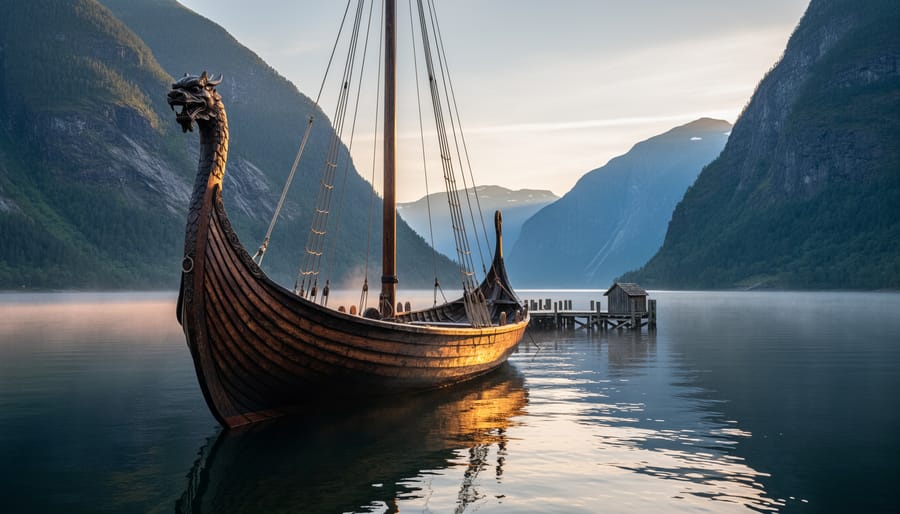
Norway’s Viking Age spans roughly from 793 CE to 1066 CE, a transformative period when Norse seafarers from the coastal regions of what is now Norway became explorers, traders, raiders, and settlers who shaped medieval Europe and beyond.
Far from the one-dimensional image of horned-helmet warriors (a myth, incidentally), Vikings were skilled navigators, shrewd merchants, democratic legislators, and gifted craftspeople whose influence stretched from North America to the Byzantine Empire. This era fundamentally defined Norway’s national character, establishing trade networks, governance systems, and cultural traditions that echo through Scandinavia today.
Understanding Viking history means grasping how these coastal communities built the fastest ships of their time, developed sophisticated legal assemblies called things, and created art that blended fierce symbolism with intricate beauty. Norwegian Vikings founded Dublin, colonized Iceland and Greenland, and reached North America centuries before Columbus. They weren’t simply raiders but farmers, poets, and settlers navigating a harsh landscape with remarkable ingenuity.
This guide explains what the Viking Age actually was, how Norwegian Viking society functioned day to day, the different roles Vikings played from farmer to warrior to merchant, and where you can encounter this history firsthand in Norway today. Whether you’re planning to visit reconstructed longhouses, explore burial mounds overlooking fjords, or simply want context before your trip, you’ll discover how Norway’s Viking heritage remains accessible, tangible, and surprisingly relevant to understanding modern Norwegian culture and values.
What Viking History of Norway Means
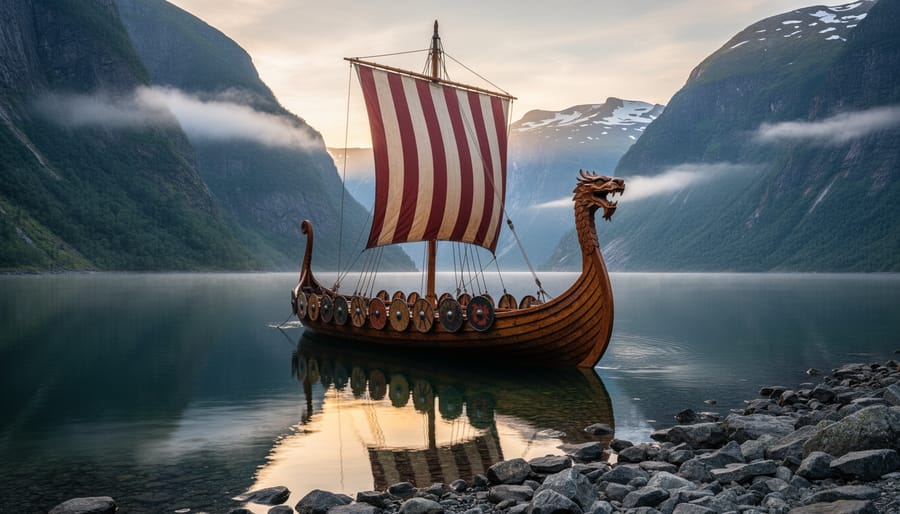
Viking History of Norway refers to the roughly 300-year period from around 793 to 1066 CE when seafaring people from the coastal regions and fjords carved by ice launched expeditions that reshaped medieval Europe. These weren’t simply raiders, Norwegian Vikings were explorers, traders, settlers, and skilled navigators who established routes across the North Atlantic and deep into European river systems.
The word “Viking” itself comes from Old Norse víkingr, likely meaning someone who ventures from the bay or creek (vík). It described an activity, going on a voyage for trade, exploration, or plunder, rather than an ethnic identity. Most people in Viking-age Norway were farmers and fishermen who never left their home valleys; only a portion went “viking” on seasonal expeditions.
Norwegian Vikings differed from their Danish and Swedish neighbors in both geography and focus. While Danish Vikings concentrated heavily on England and Francia and Swedish Vikings pushed eastward into Russia and Byzantium, Norwegians looked west. Norway’s deeply indented coastline and mountainous terrain created isolated communities along the coast, producing independent chieftains and seafarers who mastered open-ocean navigation. This geographic orientation directed Norwegian expansion toward the Shetlands, Orkneys, Hebrides, Iceland, Greenland, and eventually North America, farther west than any other medieval Europeans traveled.
- Viking
- From Old Norse víkingr, meaning a person who goes on overseas expeditions for trade, exploration, or raiding.
- Norsemen
- General term for Scandinavians during the Viking Age, particularly those from Norway (Norðmenn).
- Longship (langskip)
- The iconic shallow-draft warship that could navigate both open seas and rivers, enabling Viking expansion.
- Thing
- Regional assembly where free men gathered to settle disputes, make laws, and conduct community business, an early form of representative governance.
- Jarl
- A Norse chieftain or nobleman who controlled territory and led warriors, ranking below kings but above ordinary free farmers (karls).
- Saga
- Prose narratives written in medieval Iceland that preserve stories of Viking-age heroes, settlements, and family histories.
Norway’s central role in Viking expansion stemmed from necessity as much as ambition. Limited farmland in mountainous terrain pushed ambitious Norwegians seaward, while their unmatched shipbuilding skills and coastal expertise made long-distance voyages feasible. Understanding this context transforms how we see the Viking Age, not as random violence, but as a complex period of migration, cultural exchange, and nation-building that fundamentally shaped Norway’s identity.
How Norwegian Viking Society Worked
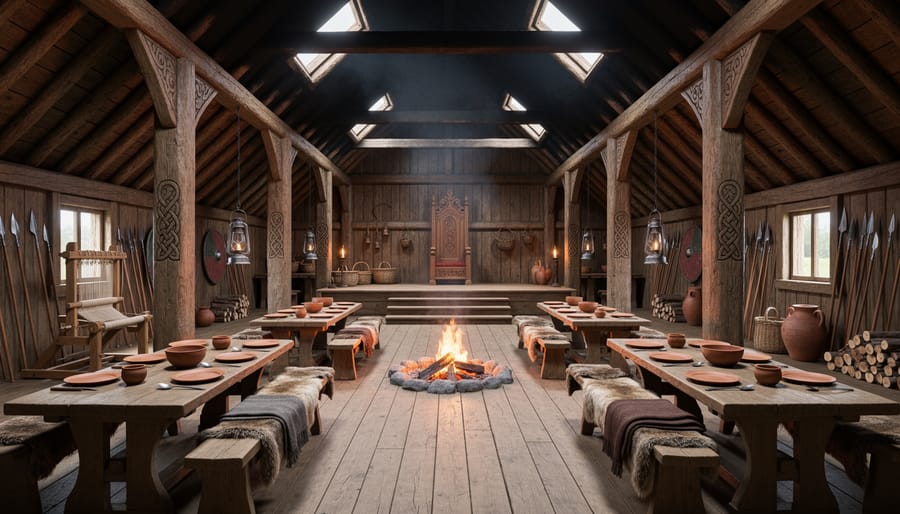
The Role of the Thing Assembly
The Thing assembly stands as one of Viking Norway’s most remarkable contributions to governance, a gathering where free men met to settle disputes, pass laws, and make collective decisions long before modern democracy took root.
Regional Things convened at designated outdoor sites, often marked by ancient stones or natural landmarks. Chieftains and landowners traveled from surrounding settlements to participate in these assemblies, which typically occurred several times per year. Thing assemblies resolved disputes through public debate and collective judgment rather than arbitrary rule by a single authority.
The process was surprisingly sophisticated. Cases were presented, witnesses testified, and the assembly members deliberated before reaching verdicts. Punishments ranged from fines and compensation payments to outlawry, banishment from the community, which effectively meant social and economic death in Viking society.
Beyond legal matters, Things served as social and political forums where communities strengthened bonds, arranged marriages, and discussed trade. The largest gathering, the Gulating in Western Norway, drew participants from vast territories and established laws that influenced the entire region.
This tradition wasn’t merely symbolic. The Thing system created accountability and gave landowners genuine voice in governance, a radical concept for the era that laid groundwork for Norway’s democratic values centuries before most European nations embraced representative government.
Viking Trade and Craftsmanship
Norwegian Vikings were far more than raiders, they were sophisticated traders who established commercial networks stretching from Baghdad to Byzantium. Their merchant ships carried prized Norwegian goods: thick furs from Arctic animals, walrus ivory from northern waters, iron from bog deposits, and soapstone carved into cooking vessels. These items commanded high prices in European and Mediterranean markets.
Viking craftspeople mastered metalworking, creating intricate jewelry from silver and bronze using techniques like filigree and granulation. Blacksmiths forged everything from everyday tools to pattern-welded swords, while woodcarvers produced elaborately decorated household items and ship ornaments. Women wove high-quality textiles using vertical looms, and their cloth became another valuable trade commodity.
Trading centers like Kaupang in Vestfold functioned as international marketplaces where Norwegian goods met imports like glass beads, silk, and spices. Merchants used standardized silver weights to conduct transactions, cutting coins and jewelry into precise portions for payment. This commercial expertise required mathematical skills, knowledge of foreign languages, and understanding of distant cultures, challenging the simplistic warrior stereotype and revealing Vikings as economically shrewd businesspeople who built prosperity through trade as much as through conquest.
Types of Norwegian Viking Activities and Roles
Norwegian Vikings as Explorers
Norwegian Vikings pushed farther west across the Atlantic than any Europeans before them, driven by a combination of adventure, overpopulation, and the search for new farmland. Starting in the late 8th century, seafarers from western Norway’s fjord communities began settling the Faroe Islands, then Iceland around 870 CE. These weren’t random raids, they were deliberate colonization efforts, with entire families loading livestock, tools, and household goods onto sturdy knarr cargo ships.
Erik the Red, exiled from Iceland for manslaughter around 982, ventured even farther. He explored Greenland’s southwestern coast and established the first Norse settlements there, convincing hundreds of Icelanders to join him by naming it “Greenland” as a marketing tactic. His son, Leif Erikson, took exploration to its limit around 1000 CE, reaching Vinland (present-day Newfoundland), making Norwegians the first confirmed Europeans in North America, nearly 500 years before Columbus.
These journeys required exceptional seamanship and courage. Crossing open ocean without compasses meant reading stars, observing seabirds, and trusting wave patterns. The settlements they established created a Norse Atlantic network that lasted for centuries.
Raiders and Warriors
The Norwegian Vikings who sailed to raid were not mindless barbarians, they were strategic operators responding to specific pressures and opportunities. Most raids targeted monasteries and coastal settlements because these sites held concentrated wealth yet lacked military defenses. Churches stored silver, gold, and valuable manuscripts; taking them required minimal risk compared to attacking fortified towns.
Economic necessity drove many raids. Norway’s mountainous terrain limited farmland, creating pressure on younger sons who wouldn’t inherit family land. Raiding offered a path to wealth and status that farming couldn’t provide. A successful raid could fund land purchases back home, finance trade voyages, or secure resources for marriage.
Political motivations mattered too. Chieftains needed to reward loyal followers with treasure and prestige. A leader who couldn’t deliver lost warriors to rival jarls. Raiding also served as military training and crew bonding before longer trade expeditions.
Yes, the violence was real, chronicles document the fear these attacks caused. But understanding the context helps explain why raiding became central to Norwegian Viking culture for roughly two centuries, then largely ceased as Christianity spread and Norway unified under stronger kings who channeled warrior energy into trade and territorial expansion instead.
Settlers and Community Builders
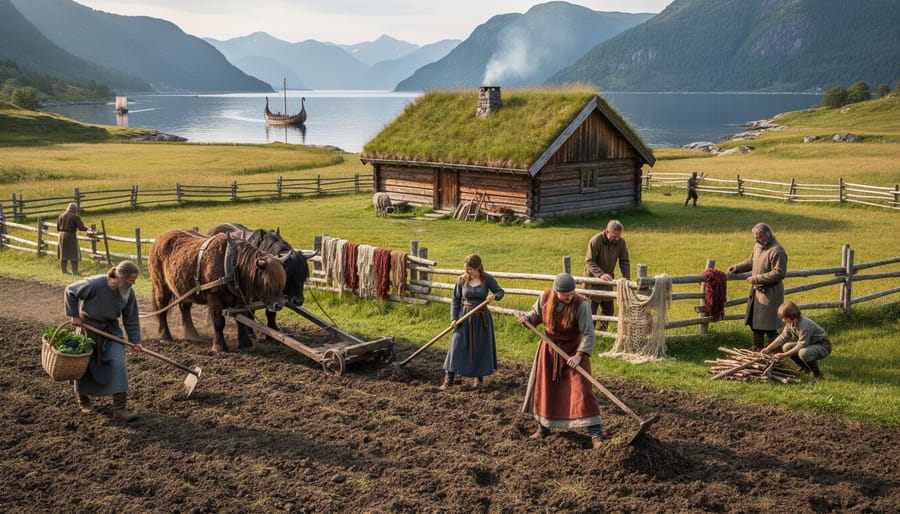
Norwegian Vikings didn’t just raid and retreat, they put down roots. When they arrived in new lands, many stayed to farm, raise families, and build communities that lasted centuries. In Iceland, Norwegian settlers established a functioning society by 930 CE, complete with their own legal assembly. These weren’t temporary camps but permanent homesteads with livestock, fields, and extended family networks.
The integration process varied by location. In the Scottish islands and Ireland, Norwegian settlers intermarried with local populations, creating distinct Norse-Gaelic cultures. Archaeological evidence from places like Orkney shows Norwegian longhouses built alongside local structures, suggesting coexistence rather than conquest. In Normandy, Vikings who’d sailed from Norwegian waters eventually adopted French language and customs while maintaining some Norse traditions, their descendants would later conquer England in 1066.
These settlers brought Norwegian shipbuilding techniques, agricultural methods, and social structures to their new homes. Women played crucial roles, managing households and maintaining cultural traditions. The settlements weren’t perfect replicas of Norwegian society but adaptive communities that blended Norse customs with local practices, creating lasting legacies across the North Atlantic world.
The Unification of Norway Under Viking Kings
Before Harald Fairhair stood victorious at Hafrsfjord around 872, Norway existed as a patchwork of independent chiefdoms ruled by regional jarls and petty kings. Each fjord settlement operated autonomously, making alliances or waging small-scale wars with neighbors. Harald Hårfagre changed this landscape forever.
The battle at Hafrsfjord near modern-day Stavanger marked a turning point. Harald defeated a coalition of rival chieftains, establishing himself as Norway’s first king with authority extending beyond his own region. Traditional accounts claim he refused to cut his hair until he united Norway, earning his nickname “Fairhair” once he achieved this goal. While historians debate the extent of his actual control, Harald created the foundation for a unified Norwegian identity. Many chieftains who refused to submit fled westward, establishing Norwegian settlements in Iceland, the Faroe Islands, and beyond.
This initial unification remained fragile. Harald’s successors fought amongst themselves, and regional powers constantly challenged royal authority. The kingdom he created fractured repeatedly over the next century.
Christianity became the force that ultimately cemented Norwegian unity. Olaf Tryggvason, who ruled from 995 to 1000, brought aggressive conversion efforts after his own baptism in England. He traveled throughout Norway destroying pagan temples and forcing chieftains to accept the new faith. His methods sparked resistance, many Norwegians clung to worship of Odin, Thor, and Freya, but Olaf established Christianity as a political tool for centralization.
Olaf II Haraldsson completed what Tryggvason started. Ruling from 1015 to 1028, he used Christianity to break the power of regional jarls who drew legitimacy from pagan traditions. When Swedish and Danish forces drove him into exile in 1028, he died attempting to reclaim his throne at the Battle of Stiklestad in 1030. Within months, miracles were reported at his grave. The Church canonized him as St. Olaf, making him Norway’s patron saint.
This transformation from regional warlord to Christian martyr gave Norway something more powerful than military conquest, a unifying spiritual symbol. Churches replaced Thing assemblies as centers of authority. The scattered chiefdoms Harald fought to control became a kingdom bound by shared faith and national identity that would endure for centuries.
How Norwegians Used Viking Ships and Navigation
The Norwegian longship stands as one of history’s most ingenious engineering achievements, purpose-built for the diverse challenges of Scandinavian waters. These vessels combined shallow drafts with oceangoing capability, allowing Vikings to sail open Atlantic swells and then glide up rivers barely deep enough to float a modern rowboat.
Ship construction relied on clinker-built techniques, overlapping oak planks riveted together and sealed with tar mixed with animal hair or moss. This flexible hull design absorbed wave impacts rather than fighting them, making longships remarkably seaworthy despite their open decks. The shallow keel, often drawing less than a metre of water, meant crews could beach their ships directly on coastlines or navigate Norway’s fjord coast with precision. A single square sail provided primary propulsion, while oars offered maneuverability in tight spaces or calm conditions.
Navigation demanded intimate knowledge rather than sophisticated instruments. Norwegian Vikings mastered coastal piloting, reading landmarks, currents, and bird flight patterns to find their way. For open-ocean crossings to Iceland or Greenland, they tracked the sun’s position and observed wave patterns. The legendary sunstone, likely a crystal of calcite or cordierite, may have helped locate the sun’s direction even through cloud cover by detecting polarized light, though debate continues about how widely this tool was used.
Skilled navigators memorized detailed mental maps of sea routes, noting water color changes that indicated depth, recognizing specific cloud formations over distant islands, and understanding seasonal wind patterns. They sailed largely by latitude sailing: reaching the correct latitude along the Norwegian coast, then heading due west until landfall. This combination of robust ship design and accumulated environmental knowledge allowed Norwegian seafarers to reach North America five centuries before Columbus, transforming them from coastal traders into transatlantic explorers.
Viking Religion and the Transition to Christianity
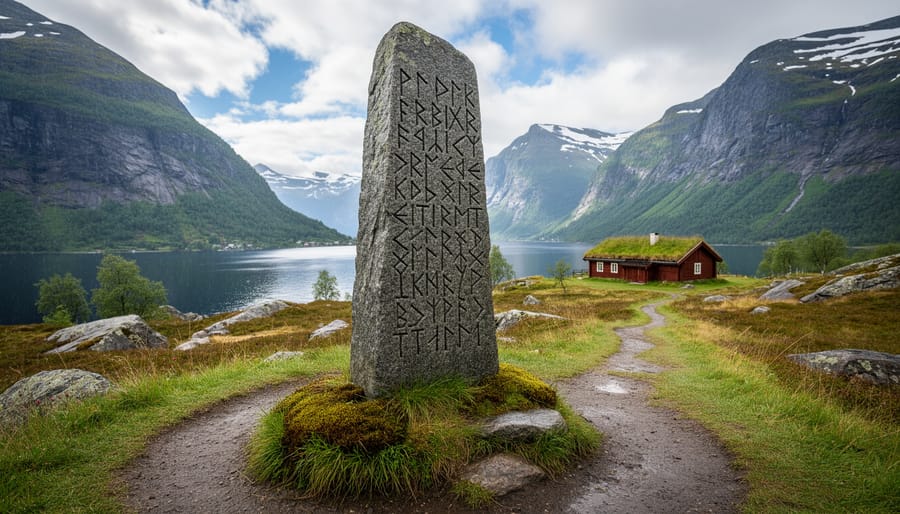
Before Christianity took root, Norwegian Vikings worshipped a pantheon of gods whose stories explained the natural forces that ruled their lives. Odin, the all-father who sacrificed an eye for wisdom, appealed to chieftains and warriors seeking knowledge and victory. Thor, the thunder god wielding his hammer Mjölnir, protected farmers and sailors from the chaos of storms and giants. Freya, goddess of love and fertility, governed matters of the heart and harvest. These deities weren’t distant abstractions but active participants in daily existence, honored through sacrifices at sacred groves, burial rituals, and seasonal festivals timed to agricultural cycles and celestial events like the midnight sun and Northern Lights seasons.
Christianity arrived gradually through trade contacts and missionary kings, but the official shift came around 995 CE when Olaf Tryggvason began forceful conversions. His successor, Olaf II (later St. Olaf), completed the transformation by 1030, though coercion often preceded genuine belief. Chieftains accepted baptism to maintain power, and pagan practices went underground rather than disappearing. Farmsteads hid Thor’s hammer amulets alongside Christian crosses. Sacred groves became church sites. The old gods lingered in folk tales and seasonal customs, blending with Christian saints in ways that still surface in Norwegian traditions today.
This religious fusion shaped Norway’s cultural DNA. You can trace this syncretism when you explore Bergen where medieval churches stand near sites once dedicated to Norse worship, or visit museums that display runestones invoking both Thor and Christ. The conversion didn’t erase Viking spirituality; it layered new beliefs atop old, creating a uniquely Norwegian Christianity that remembered the Bergen fjords and mountains as sacred long before missionaries arrived.
Where Viking History Comes Alive in Norway Today
Museums and Authentic Artifacts
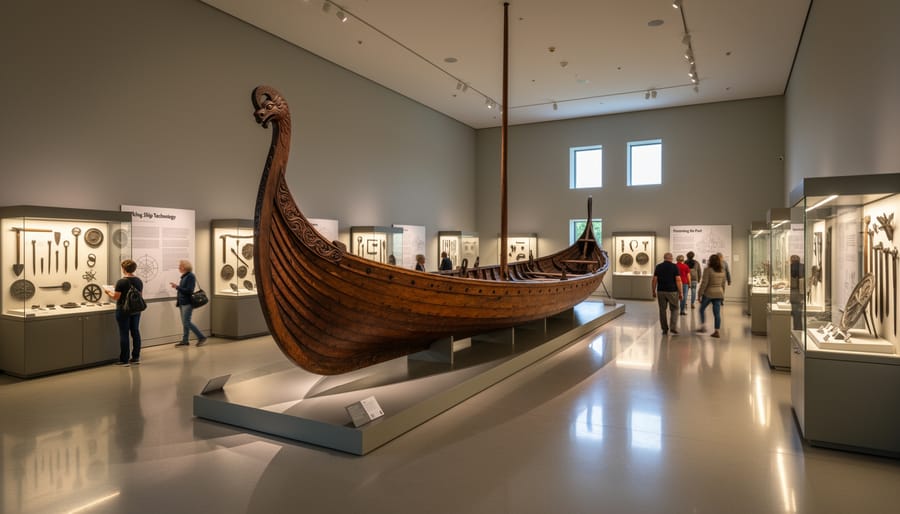
The Viking Ship Museum in Oslo houses three remarkably preserved 9th-century vessels, the Oseberg, Gokstad, and Tune ships, excavated from burial mounds along the Oslofjord. These aren’t replicas; you’re viewing the actual wood that carried Viking-age Norwegians across seas over a thousand years ago. The Oseberg ship, buried with a high-status woman around 834 CE, includes intricately carved sleds, textiles, and everyday objects that reveal how elite Norwegians lived and what they valued enough to send into the afterlife.
Oslo’s Museum of Cultural History displays Norway’s largest collection of Viking artifacts, including swords, jewelry, and tools that show the craftsmanship behind this society. Outside the capital, Trondheim‘s NTNU University Museum presents finds from central Norway’s Viking chieftains, while Bergen’s Museum features artifacts from western Norwegian settlements. Stavanger’s Archaeological Museum in Rogaland, the region where Norway unified, displays treasures from the Battle of Hafrsfjord era. These regional collections reveal how Viking culture varied across Norway’s geography, from coastal traders to inland farmers.
Living History Sites and Festivals
For a truly immersive experience, visit reconstructed Viking settlements where history isn’t confined to glass cases. The Lofotr Viking Museum in Lofoten stands out as Norway’s most authentic living history site. Here you’ll walk through a full-scale reconstruction of a chieftain’s longhouse, the largest Viking building ever discovered, stretching 83 meters along Vestvågøya island. During summer months, costumed guides demonstrate ancient crafts like weaving, blacksmithing, and bread-baking using historically accurate methods.
In Borre, near Horten, the Midgard Viking Centre brings the era alive through hands-on workshops where you can try your hand at axe-throwing, archery, or rowing a replica Viking boat. The center sits adjacent to Norway’s largest collection of burial mounds, creating a powerful connection between archaeological evidence and lived experience.
Time your visit around one of Norway’s Viking festivals for the full sensory experience. The Viking Festival in Karmøy each June transforms the island into a bustling Viking-age marketplace, complete with combat demonstrations, traditional music, and craft stalls selling handmade goods using period techniques. Smaller festivals in Avaldsnes and Gudvangen offer similarly authentic experiences without overwhelming crowds, perfect for families seeking hands-on cultural education.
Lesser-Known Viking Sites
Venture beyond the crowded museums to discover Norway’s hidden Viking treasures scattered across the countryside. Vestfold County harbors an exceptional concentration of burial mounds, including the atmospheric Gokstad and Oseberg mound sites where the famous ships were originally buried. In rural Rogaland and Sogn og Fjordane, weathered rune stones stand quietly in farmers’ fields, telling thousand-year-old stories of journeys, losses, and land ownership. The coastal settlement remains at Karmøy offer a glimpse of everyday Viking life without the tourist infrastructure of larger attractions. These lesser-visited sites provide more contemplative experiences and support local communities rather than overwhelming popular destinations. Visit during shoulder seasons, respect private property boundaries, and consider hiring local guides who can share regional Viking histories rarely found in guidebooks.
How Viking History of Norway Works
Understanding how Viking history actually unfolded in Norway requires looking at the mechanisms that drove this era forward. The process wasn’t a single event but an interconnected system of social, economic, and technological forces.
Norway’s rugged geography created isolated farming communities along fjords and coastal areas. These settlements operated independently under local chieftains who controlled resources and trade routes. When populations grew and farmland became scarce, younger sons with no inheritance prospects faced a choice: accept lower status at home or seek fortune elsewhere.
This demographic pressure combined with revolutionary shipbuilding technology. Norwegian craftsmen perfected the longship design around 700 CE, creating vessels that could cross oceans yet navigate shallow rivers. Suddenly, wealthy monasteries and trading centers across Europe became accessible targets.
The Viking Age operated on a seasonal cycle. Farmers would plant crops in spring, then crews of 30-60 men would sail out for summer raiding or trading expeditions. They’d return before harvest with silver, slaves, and goods that elevated their social standing. Successful warriors attracted followers, gained political power, and eventually challenged rival chieftains.
This pattern repeated across generations, with each successful voyage funding the next. The accumulated wealth and connections gradually shifted Norway from scattered farmsteads toward centralized kingdoms, ultimately transforming isolated Norse communities into a unified nation.
How Viking History of Norway Is Used
Norway’s Viking heritage isn’t just preserved in museums, it actively shapes the nation’s modern identity, economy, and cultural practices in tangible ways.
The tourism industry leverages Viking history as a cornerstone attraction, drawing visitors to archaeological sites, replica villages, and themed experiences. Towns like Gudvangen and Avaldsnes have built sustainable tourism economies around authentic Viking reconstructions, creating jobs while preserving cultural knowledge. Tour operators offer fjord cruises that trace historical trade routes, connecting travelers to the landscape Vikings actually navigated.
Educational programs use Viking history to teach students about governance, craftsmanship, and Norse values like community resilience. Schools organize trips to heritage sites, and many Norwegian children participate in hands-on workshops where they learn traditional skills, tablet weaving, rune carving, or boat-building techniques, that foster appreciation for their ancestors’ ingenuity.
Norway’s design and craftsmanship industries draw inspiration from Viking aesthetics. Jewelry makers reproduce intricate Norse patterns, furniture designers echo the clean lines of Viking woodwork, and architects incorporate elements that recall longhouse construction. These aren’t mere copies but contemporary interpretations that keep Viking artistry relevant.
Even Norway’s democratic traditions trace back to the Thing assemblies, reminding citizens that participatory governance has deep roots in their national story.
Understanding Viking history transforms your experience of Norway from a scenic vacation into a deeper cultural journey. The echoes of the Viking Age aren’t confined to museum displays, they live in the democratic traditions that began with the Thing assemblies, in the seafaring spirit that still defines coastal communities, and in the values of self-reliance and exploration that shape modern Norwegian identity.
When you stand before a reconstructed longship or walk through ancient burial mounds, you’re connecting with ancestors who fundamentally shaped Northern European civilization. These weren’t just raiders, but explorers who reached North America five centuries before Columbus, traders who linked continents, and farmers who carved communities from harsh landscapes. Their legacy of resilience, innovation, and adaptability remains visible in how Norwegians approach everything from sustainable resource management to egalitarian social structures.
Approaching Viking heritage sites with respect and environmental awareness honors both the past and Norway’s contemporary values. Choose smaller museums and lesser-known archaeological sites alongside major attractions. Support local guides who bring authentic stories to life rather than Hollywood stereotypes. Travel during shoulder seasons to reduce pressure on popular locations.
The Viking Age ended nearly a millennium ago, yet its influence persists in language, law, art, and the Norwegian relationship with the sea and land. By understanding this foundation, you’ll see modern Norway through clearer eyes, recognizing how a thousand-year-old heritage continues shaping a forward-thinking nation that balances tradition with progress.